



Building a successful mining project is increasingly complex. To realize its full value, companies must challenge the assumptions behind conceptual decisions.
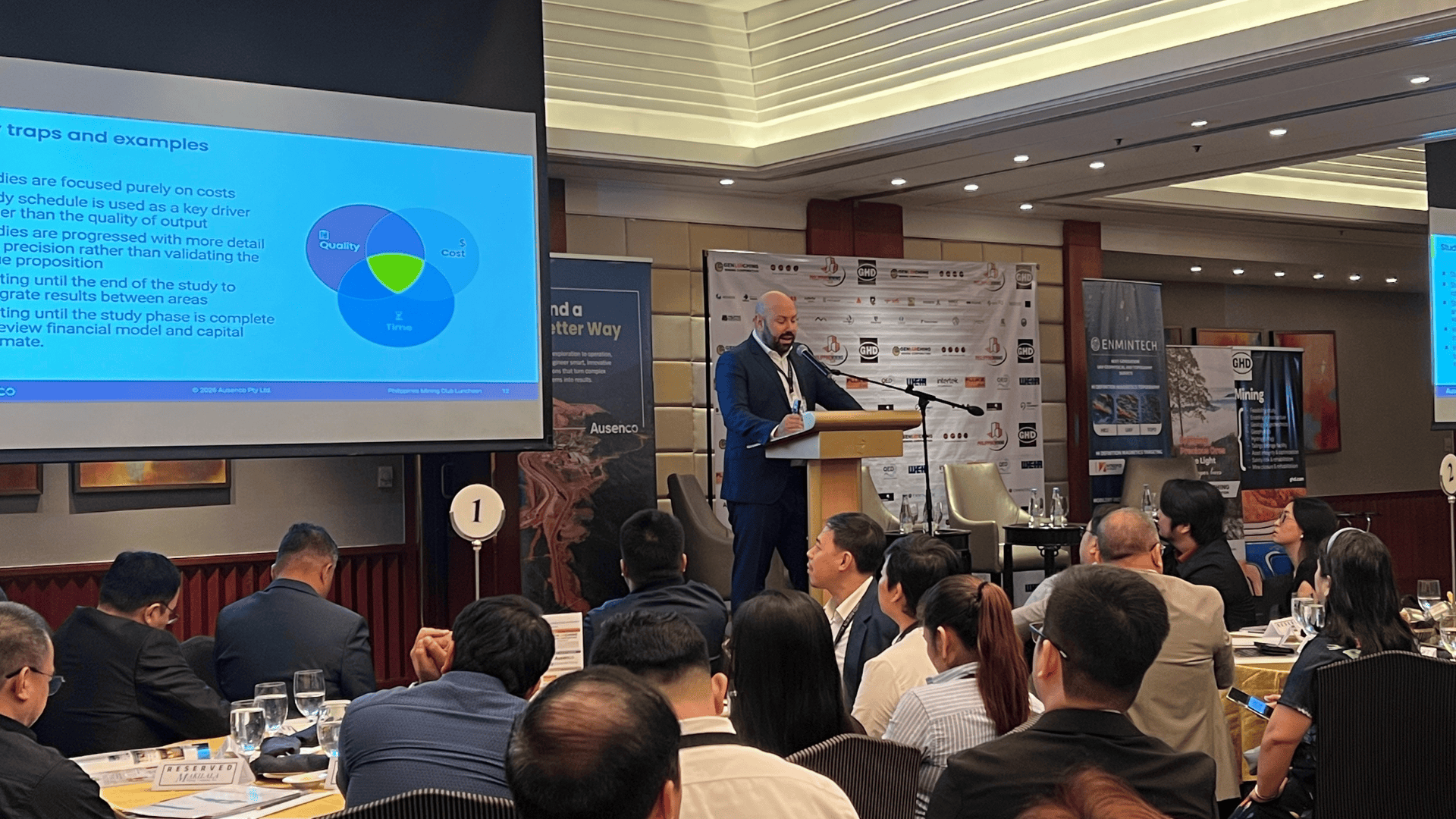
Ausenco Vice President Chris Pitman explained this as he presented the EY Top Business Risks and Opportunities survey during the 82nd Philippine Mining Club (PMC) Luncheon on Friday, February 13, at the Makati Shangri-La.
The survey, which was based on the responses of 500 anonymous senior leaders in mining and metals organizations with at least USD 1 billion in revenue, listed operational complexity as the top risk for mining companies in 2026.
According to Pitman, operational complexity stems from deeper, more complex ore bodies, increased variability, and declining grades.
“The average grade of copper mined worldwide has fallen 40% since 1991. Rising costs and productivity remain near the top, primarily driven by energy and labour costs, and as does access to capital,†he said.
Pitman noted that rising energy and labor costs, along with tighter access to capital and higher interest rates, are making projects more expensive and pushing companies to explore alternative financing options, including government incentives.
“All of these risks and opportunities could and should be addressed in your study phase. Of course, they can be dealt with once a mine is in operation, too, but for some projects, that just may be too late,†he stressed.
During his presentation, Pitman described a study as the process of defining what a mining project should look like, starting with a diverging phase to generate ideas and questions, followed by a converging phase to finalize answers, designs, and engineering. Its outcome is a feasible project ready for execution.
“Unfortunately, in many studies, the decisions are made for the wrong reasons. Maybe you’re driving a lower CAPEX through cheaper equipment. Maybe it’s trying to push tonnes or high grades the first few years,†Pitman said.
“But without challenging the underlying assumptions behind these decisions, projects leave opportunities on the table, and unmitigated risks can come back to bite you later,†he added.
Pitman said feasibility studies or value engineering often yield only incremental changes unless the underlying assumptions and conceptual decisions are challenged.Â
But without addressing these fundamentals, he stressed that even a well-planned project may fail to realize its full value.
During the study phase, Pitman said it is important to consider stakeholder drivers, such as renewable energy, ESG standards, and contractor engagement, along with understanding product marketability and end-user requirements, because these shape the project’s contingency and risk profiles.
The goal, Pitman advised, is to add value at every stage of the study and preserve it through execution.
“The overall goal of a business is to make money. And with more money, you can unlock more projects, plan for the future, throughput upgrades, all of which are good for business, good for the industry,†he said.
In what ways do you think companies can maximize the value of a mining project during its planning and study phases?
Follow Ang Minero on Facebook and LinkedIn for more updates.