



Photo credit: TVIRD
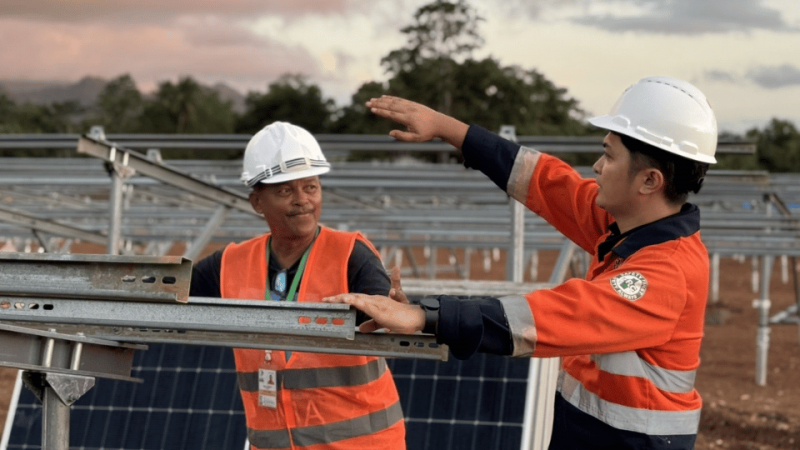
TVI Resource Development Philippines Inc. (TVIRD) has integrated a 5.3-megawatt-peak (MWp) solar power facility into its Siana Gold Project operations, marking one of the first large-scale solar deployments within a mining site in the Caraga region.
The facility, developed under Greenstone Resource Corporation (GRC), is designed to partially offset the Siana Gold Project’s electricity demand and reduce dependence on grid power, which mining operators in remote areas often cite as a constraint due to cost and supply variability.
“This solar farm project is the first of its kind here in the Caraga Region where a mining company really put up a large-scale solar farm to help offset its energy requirements and strengthen its power supply,” Mines and Geosciences Bureau (MGB) Region XIII Director Engr. Francis Glenn Suante said during the energization of Phase 1 of the project.
The Siana Gold Mine is an open-pit and planned underground gold and silver mining operation located in Tubod, Surigao del Norte, around 35 kilometres south of Surigao City in the Caraga Region. It is operated by GRC, an affiliate of TVIRD.
Situated within one of the Philippines’ most mineral-rich belts along the Surigao Valley Fault system, the site hosts epithermal gold and associated mineralisation, with estimated reserves of around 3.1 million tonnes of ore grading approximately 3.4 grams of gold per tonne.
Milling operations at the site resumed in March 2024, with a reported throughput capacity of about 2,300 tonnes per day, as part of the project’s phased restart and continued development.
Greenstone Solar Farm Project Head Engr. Rico Hernandez said the solar installation reflects a structural shift in how mining operations are incorporating renewable energy into core infrastructure rather than treating it as a supplementary input.
“I see this as a major milestone for the mining industry, showing that large-scale operations can effectively tie up with the renewable energy sector,” Hernandez said.
The Siana solar facility is expected to generate about 7,943,000 kilowatt-hours annually, supplying roughly 16% of the process plant’s total electricity requirements once fully operational.
The project footprint spans 15.65 hectares and is projected to reduce emissions by more than 4,100 tons of CO2, equivalent to the carbon absorption of over 190,000 trees, according to company estimates.
Hernandez said the project’s timing was supported by enabling site conditions, including available land, defined load requirements, and grid interconnection capacity, which allowed construction to proceed alongside ongoing mining operations.
He also cited external cost pressures as a factor accelerating adoption, particularly rising fuel prices and anticipated increases in electricity tariffs, which have strengthened the economic case for on-site renewable generation in energy-intensive industries.
The project is being implemented in partnership with PAVI Green Renewable Energy, Inc., reflecting a growing model of collaboration between industrial operators and renewable energy developers in the Philippines’ mining sector.
Beyond cost and reliability considerations, TVIRD said the project reflects a broader shift in energy management strategy within its operations.
“We’re moving from just consuming energy to actually managing and optimizing where our energy comes from,” Hernandez said.
The company said the solar integration forms part of a wider effort to improve energy resilience and reduce the carbon intensity of its operations at Siana, which remains exposed to grid volatility typical of off-mainline industrial sites.
The solar plant is expected to be completed by May 31.
How scalable is embedded solar generation in Philippine mining operations, and could similar hybrid energy models materially reduce grid dependence across other energy-intensive industries in remote provinces?
Follow Ang Minero on Facebook and LinkedIn for more updates.